


Convergence and regulatory reliance


IFPMA promotes globally coordinated approaches that bring together regulators, industry, and health authorities to evolve regulatory systems in step with scientific progress.
Overview
Regulatory convergence and regulatory reliance help national regulatory authorities (NRAs), regional regulatory bodies, and global regulatory networks enable resilient health systems, while ensuring safe, effective, and quality-assured medical products are available to patients.
Convergence
IFPMA contributes industry expertise to developing converged, harmonized norms and standards that enable adequate quality, safety, and efficacy control of medical products globally.
In the past few decades, regional mechanisms and networks intended to harmonize regulations across national boundaries have developed in Europe, Asia, Africa, and Latin America. These mechanisms and networks include the International Council for Harmonisation of Technical Requirements for Pharmaceuticals for Human Use (ICH), the International Coalition of Medicines Regulatory Authorities, International Pharmaceutical Regulators Programme, PIC/S and the World Health Organization (WHO).
As well as actively supporting these networks, we help forge and extend links between harmonization initiatives that strengthen all regulatory systems.
The International Council for Harmonisation (ICH)
As a Standing Observer of ICH, IFPMA along with other ICH Members and Observers, has an important role in promoting global convergence toward ICH regulatory standards and their harmonized interpretation.
Regulatory reliance
Regulatory reliance is the basis of processes by which a regulatory authority in one jurisdiction considers evaluations performed by another regulatory authority, while remaining responsible and accountable for its own regulatory decisions.
According to the WHO, around 30% of the world’s regulatory authorities “are considered to have the functions required to ensure medicines, vaccines, and other health products work and do not harm patients.”
Regulatory reliance is a response to this challenging situation. It enables regulatory approvals and lifecycle management whilst allowing NRAs to better manage capacity and use resources in a more efficient way. As well as strengthening regulatory networks, implementing regulatory reliance ultimately serves patients by facilitating earlier access to quality-assured, safe, and effective medicines.
The role of assessment reports in enabling regulatory reliance – perspectives from the pharmaceutical industry
This paper examines the value of assessment reports in reliance-based regulatory frameworks and offers key recommendations to enhance their impact in a global regulatory environment.
Read more
Best practices for unilateral reliance for initial marketing authorization and post-approval changes
This paper reflects upon industry experience with reliance-based processes and identifies critical success factors and best practices underpinning their effective implementation.
Read more
Considerations on the use of reliance in clinical trials review
This position paper outlines the scope of regulatory reliance in clinical trials, key principles for effective reliance in clinical trial reviews, and consideration for implementing reliance in these reviews.
Read moreRegional focus: Africa
IFPMA and our members believe that regulatory systems focused on Africa must be consistent and predictable to make sure people have timely access to quality medicines and vaccines with proven quality, efficacy, and safety.
Weak or absent regulatory systems can often delay the availability of vital medical products for patients on the continent. They can also lead to low quality or fake medical products and inadequate monitoring of side-effects.
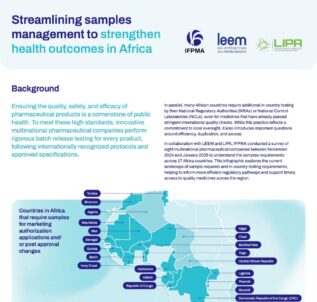
Streamlining samples management to strengthen health outcomes in Africa
Ensuring the quality, safety, and efficacy of pharmaceutical products is a cornerstone of public health. To meet these high standards, innovative multinational pharmaceutical companies perform rigorous batch release testing for every product, following internationally recognized protocols and approved specifications. However, countries may require additional in-country testing by their National Regulatory Authorities (NRAs) or National Control...
Read moreThe African Medicines Agency
The African Medicines Agency (AMA) is a specialized agency of the African Union dedicated to assisting Member States in strengthening regulatory capacity for medical products and health technologies.
For IFPMA and our members, the establishment AMA is a significant step forward when it comes to enhancing regulatory oversight and facilitating access to effective, safe, affordable, quality medicines across the Africa.
Among other things, the AMA has the potential to:
- Allow more focused resources for value-adding activities and making evidence-based scientific regulatory decisions
- Minimize administrative hurdles
- Allow for increased use of reliance-based procedures and harmonized regulatory requirements across Africa, enabling acceleration and simplification of access to medicines and vaccines to patients.
IFPMA encourages all NRAs and healthcare stakeholders to meaningfully engage and advocate for the operationalization of the AMA across African countries. We are also a member of the African Medicines Agency Treaty Alliance, whose mission is to support the rapid ratification and operationalization of the AMA.

AMATA
IFPMA is a founding member of the African Medicines Agency Treaty Alliance (AMATA) set up to advocate for the rapid ratification and implementation of the AMA.
Supporting Africa's health ecosystem
In an increasingly globalized world, no single regulatory stakeholder can meet current challenges alone. Through collaboration, ongoing dialogue and sharing of best practices, these challenges can be tackled together, especially in Africa.
Related news and resources
See allThe African Medicines Agency
We call upon all countries to ratify the AMA Treaty to enable the operational implementation of the continental regulatory system that will benefit patients, regulators, industry and healthcare systems in Africa.
Read more
Patients, product development partnerships and private health sector representatives call for the rapid ratification of the African Medicines Agency Treaty to speed up timelines to vaccines and medicines approval
On the eve of the 34th African Union Summit, two years after the Treaty to establish an African Medicines Agency was agreed, over 40 leading organizations who represent hundreds of thousands of patients, product development partnerships, youth groups, researchers and industry leaders, are urging Heads of State and Government to ratify the Treaty as a matter of priority. Delaying the establishment of an African Medicines Agency (AMA) undermines the timely access to effective, quality therapies, and vaccines for all patients across Africa.
Read more76th WHO Regional Committee for Africa: Special update on the ongoing Ebola virus disease outbreak caused by Bundibugyo Virus
On 26 August, IFPMA delivered a statement on the special update on the ongoing Ebola virus disease outbreak caused by Bundibugyo Virus at the 76th session off the WHO Regional Committee for Africa in Addis Ababa. Marking the 100th day after the Bundibugyo outbreak was declared, the global pharmaceutical industry underscores its commitment and track...
Read moreOther regulatory topics
See all
Advanced therapies
IFPMA spotlights how the innovative pharmaceutical industry is delivering a new generation of treatments while explaining the science-based regulatory requirements needed to make sure they deliver maximum therapeutic impact.

Quality, safety, and efficacy of therapeutical products
IFPMA collaborates with the World Health Organization (WHO), regulatory, and other standard-setting bodies to share experience and scientific input and implement guidelines standardizing the quality of medicines and vaccines.