

R&D innovation
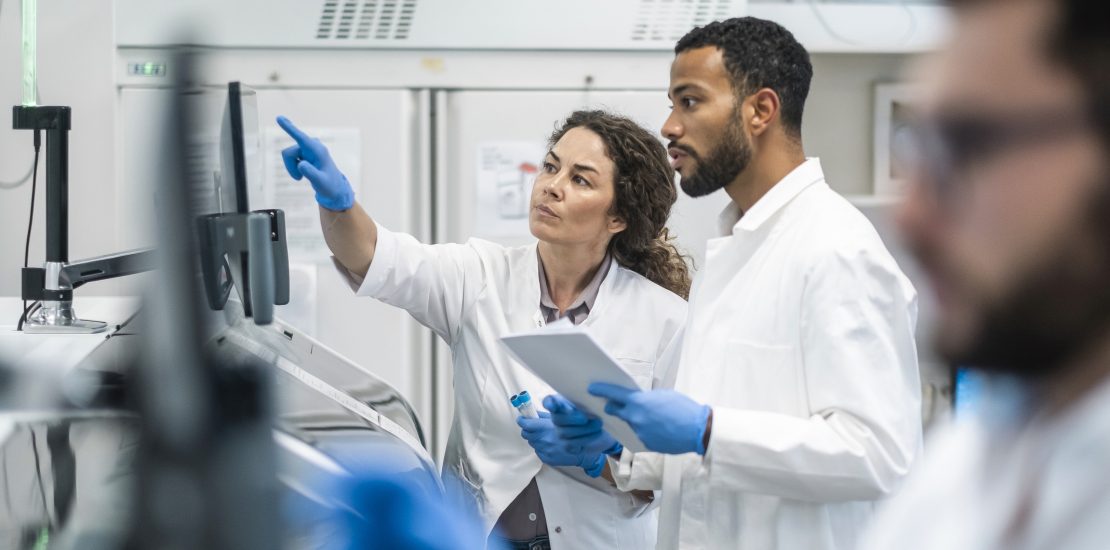
IFPMA promotes how evolving approaches to R&D – including data-driven science and artificial intelligence – can accelerate progress and support stronger innovation capacity worldwide.
Overview
Pharmaceutical R&D is central to improving health outcomes and driving economic and societal progress. IFPMA works to strengthen understanding of how innovation happens – and why it matters – while supporting trust in science and enabling the conditions needed for sustained innovation globally, including in lower-resourced settings.
In 2025, over 12,900 medicines were in clinical development globally
In 2022, the pharmaceutical sector’s R&D activities contributed USD 227 billion GDP globally
Of the 7.8 million people directly employed by the pharmaceutical industry, over 1 million are involved in R&D activities
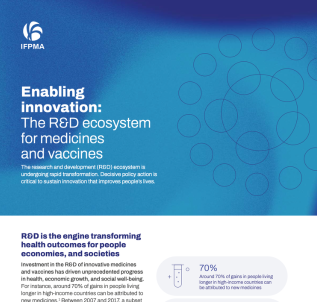
Enabling innovation: The R&D ecosystem for medicines and vaccines
Decisive policy action is critical to sustain innovation that improves people’s lives. This position paper illustrates the R&D ecosystem in action, and underscores the importance of continued commitment by governments and across stakeholders to ensure the conditions that enable the development and delivery of transformative medicines and vaccines.
Read moreDeveloping the next generation of medicines and vaccines
Bringing a new medicine to market requires decades of accumulated scientific expertise, sustained institutional commitment, and substantial financial investment.
Development timelines are long, attrition rates are high, and success depends on a convergence of biology, chemistry, clinical science, and regulatory know-how built across the full innovation ecosystem – from academic research and biotechs to large pharmaceutical companies.
Breakthrough medicines do not emerge from science alone. They require a sustained, coherent policy ecosystem that rewards long-term, high-risk investment and creates the conditions for scientific ambition to translate into benefits for people, societies, and economies.
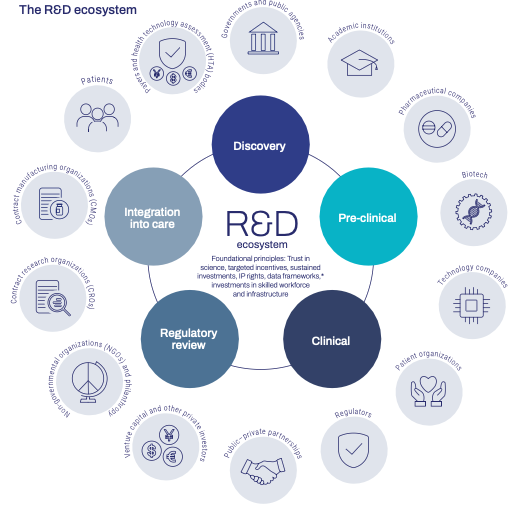

Policies should support a sustainable ecosystem for delivering on health innovation.
This requires a stable and predictable environment, including intellectual property frameworks that reward long-term, high-risk investment; regulatory pathways that are proportionate, convergent across markets, and adapted to the growing complexity of modern R&D; and trade and data frameworks that enable the cross-border collaboration on which pharmaceutical innovation depends.
Leveraging data-driven R&D
Global pharmaceutical R&D leverages many different types of data, including real world patient experiences, health system information, and foundational scientific data.
When these data sets are high quality, secure, and responsibly shared and used, they can shorten the time it takes to develop new medicines and vaccines, improve safety monitoring, and support more effective and personalized care for patients. Growing technological capability, including the use of AI-enhanced processes in relation to data analysis and R&D, can further lead to improved health outcomes.
The innovative pharmaceutical industry focuses on delivering R&D to meet the medical needs of patients and populations of today and tomorrow. We rely on a data ecosystem that can support this mission and caution against overly prescriptive, hyper-localized policies, with requirements that risk impeding health innovation, limiting or delaying patient access, and undermining health security.
International data flows: Enabling data-driven, patient-centric innovative pharmaceutical research and development (R&D)
To fulfill the potential of data and new technologies in supporting the shared objective of improving patient lives and population health, it is vital that well-designed systems are put in place.
Read moreEmerging technologies shaping the future of pharmaceutical innovation
The next generation of medicines and vaccines will look fundamentally different from what came before. A convergence of biological understanding and technological capability is opening doors that were not even visible a decade ago.
AI and machine learning tools are helping us gain insight into potential new treatment options and pathways and can compress timelines needed for biological target identification and screening treatment candidates. They can also help optimize clinical trial design, support administrative workload, and augment other parts of the biopharmaceutical value chain.
CRISPR-based therapies reached patients for the first time in 2024, with approvals for sickle cell disease and beta thalassaemia. The era of curative, one-time genetic interventions has begun, though scalability and delivery challenges remain.
mRNA technology – proven at scale through COVID-19 vaccines – is now being deployed for oncology, immunology, and rare diseases. The platform’s speed and adaptability make it one of the most versatile tools in the biological toolkit.
Genomic, proteomic, and biomarker data are enabling treatments tailored to individual patients. Cancer care is already being transformed. The model is expanding into rare diseases, neurology, and cardiovascular medicine.
Cell therapies – including CAR-T for haematological cancers – are demonstrating durable responses in patients with limited alternatives. Manufacturing scalability and logistics remain the field’s core challenge heading into the late 2020s.
Wearables, remote monitoring, and real-world data are generating new evidence streams that accelerate trial design, support regulatory submissions, and enable continuous post-market surveillance at previously impossible scale. Learn more here.

Advanced therapies
IFPMA supports the innovative pharmaceutical industry advance new generations of medicines, guided by science‑based regulatory systems that help ensure quality, safety, and meaningful benefit for patients worldwide.

Antimicrobial resistance
In select therapeutic areas where scientific and market challenges are particularly acute – such as antimicrobial resistance – targeted economic incentives have the potential to unlock progress where these foundations alone are insufficient.
Strengthening R&D capacity everywhere
Strengthening R&D capacity in Africa is central to advancing health innovation that is shaped by African priorities, expertise, and institutions.
Across the continent, researchers, universities, product developers, and public health actors are building the scientific and collaborative ecosystems needed to move innovation forward. Efforts such as the H3D Foundation help expand networks, skills, and platforms that support African-led drug discovery and a more connected innovation landscape.
H3D Foundation
The H3D Foundation supports drug innovation and science in Africa through initiatives to strengthen capacity, collaboration, and advocacy for African researchers and research centers. IFPMA and member companies partner with H3D Foundation to promote health innovation in Africa.
A fit-for-purpose R&D ecosystem
Given the rapid pace of scientific progress, the R&D capacity of the innovative pharmaceutical industry is more critical than ever to the development of the next generation of medicines and vaccines.

Access and benefit sharing
Lorem ipsum dolor sit amet, consectetur adipiscing elit. In orci elit, rutrum laoreet velit nec, mattis fringilla purus. Ut convallis odio id diam lacinia, in laoreet ante dictum.

Intellectual property
IFPMA fosters an understanding of the enabling role intellectual property (IP) plays in driving innovation in the pharmaceutical industry, ultimately making health breakthroughs happen.

Enabling trade
Representing an industry whose members have R&D and manufacturing operations around the world, IFPMA engages on behalf of the innovative pharmaceutical industry with global trade organizations.